Warren Piece
Into the mouth of madness with the Oscars' biggest musical loser.

There were a lot of narratives to parse through last week when the nominations for the 98th Academy Awards were announced last week on January 22. Would Sinners win any of its record-breaking 16 nominations? How fair was it that Wicked: For Good got snubbed from every category? How on earth did F1 garner a Best Picture nomination?
I don't particularly care about awards shows in general, but I was deep in a narrative after my own heart: the ongoing humiliation ritual of one of the Oscars' biggest losers. Songwriter Diane Warren earned her 17th nomination in the category of Best Original Song—and if it goes like any of the others, she'll walk away empty handed. (Others have garnered more nominations without a win; composer Victor Young died with 22 nominations and sound mixer Kevin O'Connell endured 20 without a trophy. But both their streaks ended: Young posthumously flipped it back to 21 with a Best Score win for Around the World in 80 Days and O'Connell picked up one for his work on the 2016 war film Hacksaw Ridge.)
Warren's track record at the Academy Awards is more striking, in part due to her success elsewhere. As a songwriter, she's penned some 33 Top 10 hits, nine of which went to No. 1. At one point, she had seven songs she'd written on the Billboard Hot 100, each sung by a different artist. She's been the magazine's Songwriter of the Year three years straight from 1997 to 1999, and earned positions in the Songwriters Hall of Fame and the Hollywood Walk of Fame in 2001. Her songs hit because they're the kind of plainly sentimental, generically catchy hired-gun tunes that started falling out of favor everywhere in the music business except, maybe, Nashville by the 21st century.
Her work is also notable because Warren herself is a perplexing figure. She identifies—whether formally diagnosed or not—as a person on the autism spectrum, and reportedly eschews the kind of relationships she has so often scored, though she believes this makes her a better writer of aural romance. She's only had two Top 10s in the 21st century, and one of them was a co-write with Taylor Swift on a bonus track from her re-recording of 1989. Today, she's seemingly singularly devoted to the idea of winning a competitive Academy Award: nearly every year since 2014, she's submitted a track, garnered a nomination, and come up short, like Susan Lucci with a keyboard. And in this time—perhaps because of the autism—she's earned a reputation for being outspoken about her craft (at best) and unable to keep her emotions in check (at worst). “I’m the Terminator of the Oscars," she has quipped. "I’ll be back."
I come here not to bury Diane Warren, but to offer my assessment of her body of work through her Oscar nominations. What does nearly 40 years of attempting to win look like? Does it say anything about songwriting as a whole? Will she ever break the curse she seems to be toiling under? Join me on an odyssey through her 17 nominated songs and if any of them deserved a win.
I can't get worked up about Starship the way a generation of rock critics can. "We Built This City" is hardly pop's greatest crime, and "Nothing's Gonna Stop Us Now" is unabashed in its bone-simple joys.
Starship, "Nothing's Gonna Stop Us Now" (from Mannequin, 1987)
The scene: Having proved herself a formidable staff songwriter with Top 10s like Laura Branigan's "Solitaire" and DeBarge's "Rhythm of the Night," Warren (working with legendary songwriter Albert Hammond) penned this peppy, feel-good anthem to the power of love that became her first to top the Billboard Hot 100. It featured in the movie Mannequin, a romantic comedy where Andrew McCarthy falls for Kim Cattrall, a mannequin brought to life by Egyptian magic or something.
The loss: After 1984, when MTV and corporate synergy propelled all five Best Original Song nominees to the top of the U.S. charts, it's always been interesting to see where the line is drawn between popular fare and simply entertaining film songs. "Nothing's Gonna Stop Us Now" faced off against two of the latter ("Storybook Love" from The Princess Bride and the titular song to the apartheid-era drama Cry Freedom) but faced sharpest competiton against two of the former: Bob Seger's Beverly Hills Cop II smash "Shakedown," and the ultimate winner, Bill Medley and Jennifer Warnes' "(I've Had) The Time of My Life" from the blockbuster Dirty Dancing.
Should it have won? Probably not—"Time of My Life" was a juggernaut, despite being a weirdly '80s power cut (not unlike "Nothing's Gonna Stop Us Now") inexplicably in a movie set in the '60s.
I have a great story about this song: in a college writing class, we were paired up with people to profile them in a location they felt comfortable in. The girl who wrote about me on a trip to Alwilk Record & Tape at the Livingston Mall told me about her boyfriend, an aspiring EDM musician who took a piece of lyrics from her AIM away message and made her a demo out of it, not knowing they were written by Diane Warren. It was a fragment of this very song.
Céline Dion, "Because You Loved Me" (from Up Close & Personal, 1996)
The scene: Nearly a decade after her first nomination—and several years after a near-fatal car accident that probably explains why she's always wearing a scarf—Warren's bona fides are well-established: love songs and weepy ballads that are often syrupy, nearly transcendent or both. Having already delivered a Top 10 hit for Canadian chanteuse Céline Dion (in the form of a love ballad originally written for a movie!), the pair placed another such tune—with two upward key changes, no less!—in the eminently forgettable Up Close & Personal, from a script loosely based on the memoirs of Jessica Savitch that ended up more like A Star is Born for 60 Minutes enthusiasts. (Despite the ephemeral quality of the film, the song was the No. 3 song on the year-end Hot 100, and set Dion up for even bigger things.)
The loss: "Because You Loved Me" was up against two very similar melodramatic end credits ballads at the Oscars: "For the First Time," performed by soundtrack king Kenny Loggins for the film One Fine Day, and "I Finally Found Someone," a duet from The Mirror Has Two Faces that united Barbra Streisand (and longtime collaborator Marvin Hamlisch) with unlikely partner Bryan Adams (and his longtime collaborator Robert John "Mutt" Lange). Perhaps because of that level playing field, the award ultimately went to Andrew Lloyd Webber and Tim Rice's "You Must Love Me," a song written for the Madonna-led film version of their Broadway hit Evita.
Should it have won? No, and "You Must Love Me" shouldn't have either! The fifth nominee was the utterly transcendent, are-you-sure-this-wasn't-written-30-years-ago title track from Tom Hanks' delightful That Thing You Do! The late, great Adam Schlesinger was robbed.
Though unused in the film, LeAnn Rimes' version got an incredible placement on television, in a surreal episode of the HBO dark comedy Barry.
Trisha Yearwood (or was it LeAnn Rimes), "How Do I Live" (from Con Air, 1997)
The scene: Maybe "Because You Love Me" was successful enough that a Diane Warren ballad felt like a good luck charm. That doesn't explain why she started getting placements on movies where things blow up dramatically. Con Air, the mind-boggling, Jerry Bruckheimer-produced Nicolas Cage vehicle about a plane full of ensemble criminals, was not the place you'd expect to find such a dewy-eyed love song. But that bunny was impossible to put into its box, becoming a simultaneous hit twice—once for Yearwood's countrified soundtrack version, and once in a more dramatic, heaven-shaking ballad version by upstart country-pop singer LeAnn Rimes, whose version stayed in the Top 40 for more than a year and was ranked by Billboard as the biggest song of the '90s, despite never topping the chart.
The loss: Like Con Air, the year's Best Song nominees were a fascinating hodgepodge. There was a Disney song ("Go the Distance" from Hercules), a fake Disney song ("Journey to the Past" from Anastasia), a wild card (Elliott Smith's Good Will Hunting cut "Miss Misery")...and Céline Dion's "My Heart Will Go On," the thunderous power ballad from Titanic, well on its way to becoming the most financially successful film ever made.
Should it have won? Could you have avoided that iceberg?
It's really good! Argue with someone else! The bit from the film with Liv Tyler crying as she sees her father for the last time, only it's Steven Tyler, her actual father, on the TV? Cinema!
Aerosmith, "I Don't Want to Miss a Thing" (from Armageddon, 1998)
The scene: Well, why not try to make lightning strike twice? Another Bruckheimer blockbuster—this time directed with largesse by hotshot music video director turned action hitmaker Michael Bay—gets another sappy-yet-sincere ballad sung by the unlikeliest of bands: classic rock stalwarts Aerosmith. The song became their most improbable hit, hitting No. 1 for their first and only time more than 25 years after the bad boys from Boston first released a record.
The loss: Most of the nominees were kind of ghosts of Warren's past. The melodramatic "The Prayer," from the animated film Quest for Camelot, was co-written by David Foster, who is to producing what Warren is to writing. (He oversaw "Because You Loved Me" as well as another early Warren hit, the Chicago chart-topper "Look Away." Céline Dion and Andrea Bocelli would later cover "The Prayer," too.) The obscure "A Soft Place to Fall" was from The Horse Whisperer, which, like Up Close & Personal, starred Robert Redford. And Randy Newman's "That'll Do" from Babe: Pig in the City was its own side of ham. Ultimately, the winner was Stephen Schwartz, who got R&B divas Whitney Houston and Mariah Carey to play nice on "When You Believe" from his song score to the animated flick The Prince of Egypt.
Should it have won? My love for Aerosmith is pretty well-known, as is my unironic enjoyment of this song—but even setting that aside, if anything could have broken Warren's losing streak fever, this is probably the one that could have done it. I think it should've won!
So many of Warren's Oscar-nominated songs used strings for dramatic effect; this may be the most meta of them all.
Gloria Estefan & *NSYNC, "Music of My Heart" (from Music of the Heart, 1999)
The scene: Another year, another ballad—this time, for an odd little film based on a documentary about Robert Guaspari, a passionate music teacher who fights for her livelihood in the New York City public school system. It featured an odd mix of folks including stars Meryl Streep as Guaspari and supporting turns from Gloria Estefan and Angela Bassett, plus direction from Wes Craven, the only film he made without monsters, serial killers, or monster serial killers in it. The song was a No. 2 hit, but a waste of Estefan's vocal power, and *NSYNC were due for even bigger things just a year later.
The loss: Looking at the competition, it feels like Warren was nominated on a technicality. She was up against Aimee Mann's brilliant "Save Me" (from Magnolia), Randy Newman's heartrending Toy Story 2 weeper "When She Loved Me," the bombastic Trey Parker/Marc Shaiman extravaganza "Blame Canada" from South Park: Bigger, Longer & Uncut, and winner Phil Collins for Tarzan's why-did-this-go-so-hard favorite "You'll Be in My Heart."
Should it have won? Against Phil?? Not on your life.
I think, ultimately, Warren's real gift is with melody, not lyrics. I think "There You'll Be" is where the disparity starts to show.
Faith Hill, "There You'll Be" (from Pearl Harbor, 2001)
The scene: With Warren's grip on the charts starting to slip in favor of Sweden, "There You'll Be" reads like a real back-to-the-well moment, scoring yet another Bruckheimer-Bay bruiser that inserted a ridiculous love triangle into the beginning of America's entry into World War II. (Even Céline Dion turned it down.) But honestly, Faith Hill gives it her all, and the track (co-produced by Trevor Horn, of all people) doesn't offend much.
The loss: That said, there was some wild competition. You had Enya's "May It Be" from the first Lord of the Rings film, and a few generations of classic pop/rockers including Paul McCartney ("Vanilla Sky"), Sting ("Until..." from Kate & Leopold) and winner Randy Newman (who, on his third try for a Disney/Pixar film, struck gold with "If I Didn't Have You" from Monsters Inc.).
Should it have won? Honestly, no one is on their A-game here, but that shouldn't give Diane an advantage.
Are the films that slipped through the cracks in the pre-streaming era somehow more ephemeral than the ones that can appear or disappear on there whenever? Something to think about, maybe.
Rita Ora, "Grateful" (from Beyond the Lights, 2014)
The scene: The Best Song Oscar competition will enter the 21st century at the ceremony for 2002, when rapper Eminem takes home a trophy for "Lose Yourself" from his roman a clef star turn 8 Mile. Another rap song, Hustle & Flow's Three 6 Mafia-powered "It's Hard Out Here for a Pimp," will win for 2005, but the majority of winners are stately or pleasant numbers that don't always capture the increasingly dwindling zeitgeist, even if they're good (Disney and James Bond doing bangers again being an exception).
In this context re-enters Diane Warren: perhaps she came to the same conclusions and figured her serviceable craftswomanship could cut through the static. And it would be entirely possible...if the wagons she hitched her horses to weren't so low-profile. Beyond the Lights, a well-reviewed film starring Gugu Mbatha-Raw as a rising pop star stuck between a controlling momager (Minnie Driver) and a scummy boyfriend (MGK), was warmly received by critics and audiences in a limited release, but rise-above-it ballad-with-a-beat "Grateful" sounds like a song Beyoncé would have rejected in favor of the Warren song she did record.
The loss: The zeitgeist capturing was minimal in 2014; how much is there to say about fellow nominees like Glen Campbell's "I'm Not Gonna Miss You," from his farewell documentary, or winning number "Glory," a Common/John Legend rap'n'B song tacked onto the Martin Luther King, Jr. biopic Selma? Even my personal favorite is just a solid pop tune: "Lost Stars," from John Carney (Once)'s music biz dramedy Begin Again, was penned by two great songwriters (Gregg Alexander and Danielle Brisebois of New Radicals) and sung artfully by the film's co-star, Maroon 5 frontman Adam Levine.
Should it have won? OK but wait: if they voted based on performance at the Oscars, the winner would have clearly been The LEGO Movie's goofball positivity anthem "Everything is Awesome!!!"—performed to perfection on the telecast by Teagan and Sara with The Lonely Island (and onstage cameos by film co-star Will Arnett and score composer/producer Mark Mothersbaugh of DEVO).
I actually vividly remember hearing "Til It Happens to You" at an Oscar party, being profoundly moved by it—this was a time when I guess I was wrapping my head around how prevalent misogyny and assault were in everyday life—and being absolutely sickened by a conversation two young women were having through the party about how many accusers can really make stuff up. My brother was at that same party and could tell I was upset, so he made me feel better by hyping up every nomination for that year's Mad Max: Fury Road by screaming "WAR BOYS!" in the faces of those two.
Lady Gaga, "Til It Happens to You" (from The Hunting Ground, 2015)
The scene: This is kind of where things start to shift on Warren's journey on the Oscar road. "Til It Happens to You" partly eschewed generic universality for a very real, painful subject: cases of sexual assault on college campuses that are often ignored or not taken seriously enough by educational institutions. Getting Lady Gaga—herself a rape survivor—to co-write and deliver a vocal with her expected vocal charisma and emotional resonance was a coup for Warren and the filmmakers behind The Hunting Ground, the documentary attempting to bring these cruelties to light.
The loss: Maybe the track arrived too early for the #MeToo movement, but "Til It Happens to You" came up short. Toward the front of the pack were The Weeknd's "Earned It" from Fifty Shades of Grey (one of his first major pop hits) and eventual winner "Writing's on the Wall," Sam Smith's evocative if not groundbreaking theme to the James Bond flick Spectre. (Also nominated were Anohi's "Manta Ray" from the documentary Facing Extinction and the contemporary classical tune "Simple Song #3" from the film Youth. Surprisingly not nominated were Ellie Goulding's honestly terrific "Love Me Like You Do" from Fifty Shades and Wiz Khalifa and Charlie Puth's chart-topping "See You Again," an elegy of sorts for departed Furious 7 star Paul Walker.)
Should it have won? It's hard to say. None of the others are exactly A-1 material, but "Til It Happens to You" is kind of a patch on Gaga's "Million Reasons" with sadder lyrics. But the following year—the only since 2014 without a Warren nomination—the songwriter didn't do herself a lot of favors by noncommittally slagging off Smith's win, which may be what curses this whole enterprise.
The drums...they're big!
Andra Day feat. Common, "Stand Up for Something" (from Marshall, 2017)
The scene: With no song up for an Oscar in 2016 (the year La La Land's "City of Stars" blocked Lin-Manuel Miranda from becoming an EGOT with Moana's "How Far I'll Go"), Warren re-emerged in a seeming attempt to adapt from previous losses. "Stand Up for Something" was kind of a spiritual sequel to the Selma track "Glory" (down to the Common cameo), only this time syncing to Marshall, about a civil rights case which featured future Supreme Court justice Thurgood Marshall as a pivotal lawyer.
The loss: If voters had wanted stately, grown-up R&B, they could have pulled for fellow nominee "Mighty River" from the postwar Netflix drama Mudbound, which was co-written and sung by Mary J. Blige (who also received a Best Supporting Actress nomination for the film). Far stiffer competition came from Sufjan Stevens (penning "Mystery of Love" for Call Me by Your Name), Pasek & Paul (the co-writers of La La Land's song score, here up for a tune from The Greatest Showman) and Robert and Kristen Anderson-Lopez, who'd won in 2013 for Frozen's "Let It Go" and pulled off another coup with the emotional "Remember Me" from the Disney/Pixar film Coco.
Should it have won? Not particularly.
By this point, Warren at least wants you to know she's a part of these songs, putting herself prominently in the metadata or descriptions of every one of these songs.
Jennifer Hudson, "I'll Fight" (from RBG, 2018)
The scene: Continuing to hammer the progressive inspirational anvil, Warren's next nomination came for this track from the documentary RBG, about Supreme Court justice Ruth Bader Ginsburg.
The loss: Ginsburg was a towering figure and undisputed meme for liberals, but her song could not cut through the prestige of fellow nominees, which included art-rap for Marvel (Kendrick Lamar and SZA's Black Panther cut "All the Stars"), pleasantries for Disney ("The Place Where Lost Things Go," from Mary Poppins Returns) and appeals to country ("When a Cowboy Trades His Spurs for Wings," from the Coen brothers' Old West anthology The Ballad of Buster Scruggs). The winner, ironically, was Warren's former fellow nominee Lady Gaga, having a moment with "Shallow" off the soundtrack to her version of A Star is Born.
Should it have won? My ruling is no.
The trailer for Breakthrough may have been one of the first I laughed out loud at when I saw it. It's ridiculous!
Chrissy Metz, "I'm Standing with You" (from Breakthrough, 2019)
The scene: If her last three noms couldn't square the circle of Oscar gold, "I'm Standing with You" attempted to rectangle it. Breakthrough, a bizarre Christian film about an adopted kid who miraculously recovers from a coma after falling through ice, felt like red meat to appease more right-leaning moviegoers in the first Trump administration, and Warren's beige gospel-pop is along for the ride.
The loss: Warren didn't stand a chance against returning Disney heavyweights (Robert and Kristen Anderson-Lopez for Frozen 2's "Into the Unknown," Randy Newman for Toy Story 4's "I Can't Let You Throw Yourself Away") or more inspirational tunes from Black history biopics (this time Harriet, based on abolitionist Harriet Tubman and featuring star/songwriter Cynthia Erivo on "Stand Up"). Ultimately, the winner was a well-regarded pop duo where only half its lineup earned an Oscar; Elton John and longtime lyricist Bernie Taupin picked one up for "I'm Gonna Love Me Again," the token new song from the Elton biopic Rocketman.
Should it have won? Do you think so? I sure don't!
It's wild to see the English lyrics and realize how Diane Warren it all is.
Laura Pausini, "Io sì (Seen)" (from The Life Ahead, 2020)
The scene: With COVID-19 upending Hollywood as badly as any other industry on the planet, Warren continued throwing spaghetti at the wall. "Seen" was written for an adaptation of French novel The Life Before Us, about a Holocaust survivor (Sophia Loren) bonding with a Senegalese immigrant in Italy; it's the kind of movie that became semi-important mush in the streaming era, making it perfect for Warren's generic inspiration (and Laura Pausini's Italian translation).
The loss: Again, not a lot of hugely memorable work this year. There were three blandly inspirational songs from historical dramas (The Trial of the Chicago 7, One Night in Miami... and the winner, H.E.R.'s "Fight for You" from Judas and the Black Messiah) and the semi-serious "Husavik," a fake song for the Eurovision comedy Will Ferrell co-starred in.
Should it have won? Not even in this crowd.
Reba's legend is well taken care of, but I'd love to see a killer late-career triumph from her. It's not this!
Reba McEntire, "Somehow You Do" (from Four Good Days, 2021)
The scene: Warren fires up the blandly-inspirational cannon and sets it to country mode, recruiting genre legend Reba McEntire for this anonymous song from a mother-daughter drama about the opioid crisis starring Glenn Close and Mila Kunis.
The loss: By this point, Warren is nowhere near the record for most nominations without a win. She's on record as salty about her and Gaga's loss to Sam Smith, but hasn't had nearly as high profile a collaborator since then. Yet the odds are long. Lin-Manuel Miranda is back in the running with "Dos Oruguitas" from Disney's Encanto (not even "We Don't Talk About Bruno"?), alongside Beyoncé's "Be Alive" from King Richard (yes, this is the slap year!) and even Van Morrison (who penned a tune for Kenneth Branagh's coming-of-age picture Belfast).
But the obvious front-runner is Billie Eilish, who penned a new theme to Daniel Craig's last James Bond film No Time to Die. Eilish, who turned 20 months before the broadcast, has by this point already been feted by the music industry; in 2020, she became only the second artist to sweep the "Big Four" categories of the Grammys (Record, Album and Song of the Year and Best New Artist). Combine it with the novelty of 007 and it seems a sure thing.
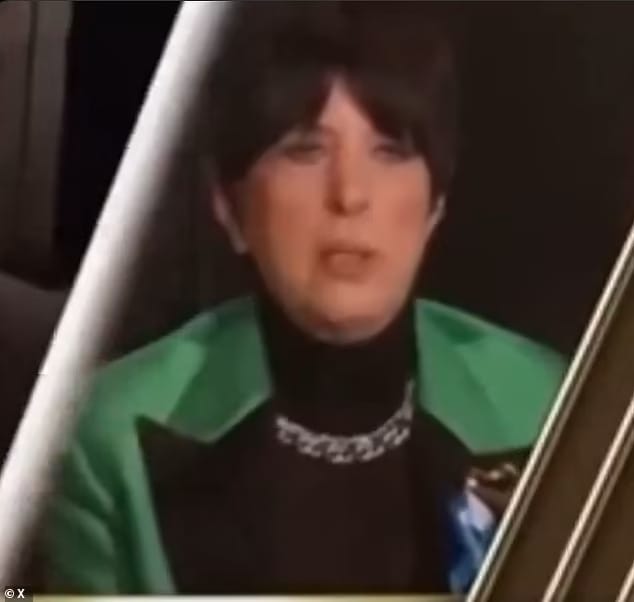
What happens is kind of shocking: Eilish and her brother/co-writer/producer Finneas O'Connell hear their names, but just behind them, you can see a green-suited Warren seated behind them, visibly reacting to her loss. She is...not happy. She does not smile. She does not clap. She does turn to someone at her table and briefly utter something that does not seem kind. This was not the first time Warren's disappointment could be registered in those little window boxes, but this was probably the one that established her as some sort of cult villain for the telecast.
Should it have won? And miss a moment like this? No way.
I'm sorry, but what this needed at least is a stronger voice.
Sofia Carson, "Applause" (from Tell It Like a Woman, 2022)
The scene: You'd think an undignified reaction after the triumph of "No Time to Die" would have inspired some reflection, or at the very least, a change in strategy for our Diane Warren. And ultimately...nope! Former Disney singer Sofia Carson is here to huskily offer this incredibly basic girl-power anthem for a series of partially-cloying short films, all directed by women.
It's also worth noting that this same year, the Academy of Motion Picture Arts and Sciences, perhaps wishing for a respite from Warren's balladry, bestowed upon her an Honorary Award, given at a separate ceremony alongside directors Peter Weir and Euzhan Palcy. (Yes, she was arguably the biggest name awarded that year, and her speech is actually pretty great!)
The loss: It's kind of a wonder Warren even got a nomination this year. She was up against songs from blockbusters including Top Gun: Maverick (Lady Gaga's "Hold My Hand"—do you think they exchanged any pleasantries at the ceremony?), Black Panther: Wakanda Forever (Rihanna's "Lift Me Up") and the night's overall winner Everything Everywhere All At Once (the David Byrne-Mitski collab "This is a Life"). But that year, there was no stopping the ultra-addictive, honestly-relevant-to-the-plot Bollywood banger "Naatu Naatu," from the epic RRR.
Should it have won? Not now, I'm trying to learn those "Naatu Naatu" moves.
I'm going to assume the guy in the beginning of the video was the real guy who Flamin' Hot is about, though I'm certainly not sure.
Becky G, "The Fire Inside" (from Flamin' Hot, 2023)
The scene: By this point, reality is starting to untether. Putting another one of Warren's feel-good, generic tunes on Flamin' Hot—the Eva Longoria-directed Hulu-exclusive biopic about the creation of Flamin' Hot Cheetos that was almost entirely debunked before a single second of the movie was even filmed—feels like a bad 30 Rock B-plot spiked with an airborne pathogen. And that's before you hear it: the junky, keyboard-hallucinated Latin beat! the mild lyrical koans! the in-the-studio music video concept where Warren insists on head-bobbing behind the mixing board! At least, unlike Cheetos, there's no obnoxious residue to clean off after "The Fire Inside" slides right through your ears.
The loss: Warren's nomination was made wilder considering who got in beside her: two prestige slots (one for an Osage language original from Killers of the Flower Moon, one for a documentary on Jon Batiste) and two for the year's biggest music-supported blockbuster—Greta Gerwig's postmodern take on Mattel's Barbie. Competition between Mark Ronson and Andrew Wyatt's mock-serious "I'm Just Ken" and "What Was I Made For?"—another aching smash by Billie Eilish—must have been stiff, but this time, Warren's reaction to losing to Eilish a second time was blessedly unseen.
Should it have won? Uh, nope.
The double-tracked harmony in the second chorus is neat—but, especially in the age of Netflix and other streaming services skipping credits, what is the point of putting a modern-ish song like this at the end of a period piece?
H.E.R., "The Journey" (from The Six Triple Eight, 2024)
The scene: Four years after winning a Best Song Oscar, Grammy darling/plainly respectable R&B artist H.E.R. records another dial-a-ballad of Warren's—this time for a blandly uplifting Netflix biopic (directed by...Tyler Perry?!) of a real, predominantly Black, all-female battalion that managed overseas postal services during World War II.
The loss: This year had some strange nominees: one by Elton John and Brandi Carlile for a fly-by Disney+ documentary about the U.K. piano man's career; a track from the prison drama Sing Sing; and two from Emilia Pérez, the ceremony's most-nominated (and by some, most-detested) film. One of them, "El Mal," was the winner.
Should it have won? The maudlin "The Journey" is perhaps vaguely more memorable than anything after "Til It Happens to You"...but maybe it's also because it's the one I've heard most recently while putting this together.
Kesha is so auto-tuned on this, it's distracting. This is not the girl who did "Praying"!
Kesha, "Dear Me" (from Diane Warren: Relentless, 2025)
The scene: Warren's tried nearly everything to win an Oscar, and her latest may be the most open declaration of intent—it's an original song to a documentary about Warren herself. Many of the people who've sung the above songs appear in the film, and multiple lines are drawn under the portrait of her as a bizarre genius (writing from a Hollywood Hills office she has neither cleaned nor rearranged since 1995) and someone who's fought hard against adversities that inexplicably come with being Diane Warren. (The year had barely started and Warren lost a beach house in the southern California wildfires, the second time she lost a residence to natural disaster after a home was damaged in the 1994 Northridge earthquake. “The animals and the rescue ranch are OK tho," she wrote on Instagram, "which is the most important thing.")
Warren has been polishing diamonds for decades at this point, and "Dear Me" feels in some ways like she can go no further: the piano can emote no deeper, Kesha's autotuned vocals can be refined no more. It is hardly the best Diane Warren song, but it is, at this moment, the most perfect one.
The odds: And it's probably got no chance in hell of winning. The title track to Train Dreams (penned by Nick Cave and The National's Bryce Dessner) and "Sweet Dreams of Joy," Nicholas Pike's original from the opera documentary Viva Verdi!, are your token curiosities. More significantly, there's "I Lied to You," written by Ludwig Göransson and Raphael Saadiq for the all-time most-nominated film, Ryan Coogler's Sinners. And then there's "Golden," the inescapable standout from Netflix's animated smash KPop Demon Hunters, which held the top spot of the Billboard Hot 100 for eight weeks last year. If anyone's going up, up, up, it's probably Huntr/x's moment.
Should she win? Wouldn't it be crazy if this was the year? But then what is the narrative? Where do you go from there? Does Diane Warren burst into the cosmos, her earthly mission complete? No, I think we need to see what insane film she hitches her wagon to next. Maybe the 18th time's the charm.