YouTube Depression Theatre: The Bearded Wonder
Watching an insider's mockumentary about my favorite director.

Like many millennials, I occasionally have a tendency to let bad emotions get the better of me, and I often numb the anxiety the best way I know how: distracting myself on the Internet. Over the last few decades I've cultivated a bank of videos that often get me out of a spiral; they're inspiring, humorous or just plain interesting. I'm going to share them with you under the heading I call "YouTube Depression Theatre," and you can put them on if you ever need to feel something.
This weekend, in one of our chillest Valentine's Day celebrations ever, Nicole and I ordered in from a nice restaurant and watched John Candy: I Like Me, the documentary on the late, beloved comedian streaming on Prime Video. Like most documentaries on cultural figures of varying impacts, it was solidly entertaining, even if I'm not sure there was a particularly compelling hook beyond "he was funny, he was kind, he died too young." A deeply Catholic Canadian who swept the death of his father from a heart attack (on Candy's fifth birthday, no less) under the proverbial rug—continually turning to eating as his anxieties over working in Hollywood and maintaining a kindness and support to family and friends continued to mount? It's a compelling story, but I don't know if the film really did or coul plumb the depths of it all.
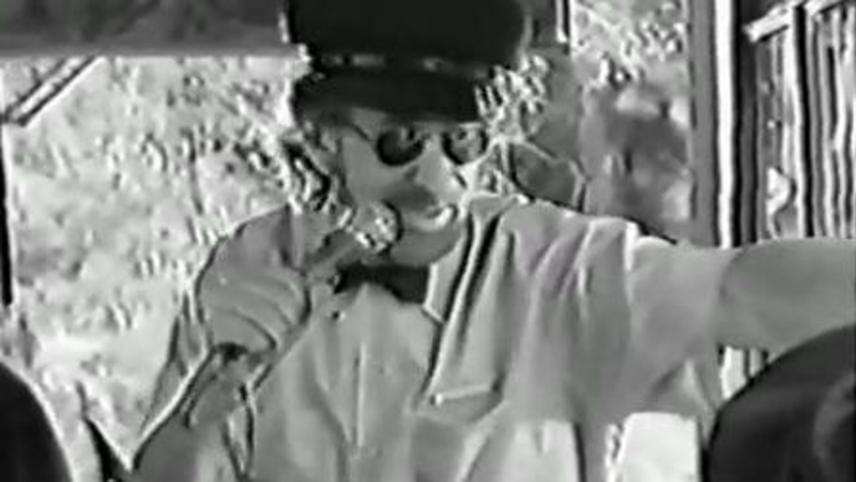
By far, the most incisive things I can say about this film is about what happens after the title fades from the screen. Fuzzy video footage shows Candy, mustached and fedora-clad, with a cigarette between his lips and a pen and notepad in his hands, trading repartee in a small screening room with a silhouetted Dan Aykroyd, pattering back and forth about getting "the whole story" of a particlar subject. Film buffs will recognize the visual parallels to the framing device of Citizen Kane, which follows a newsreel team trying to uncover the story of Orson Welles' tragic, Hearst-esque hero. But the clip is too polished, and Candy and Aykroyd too old and established, for this to date from some early collaboration at the Second City in Toronto. Who are these two trying to "get the story" about?
That's when it dawned on me: it's footage from Citizen Steve, the odd, inside-baseball short made as a 40th birthday gift for Steven Spielberg.
Citizen Steve is one of those things you have to see to believe. The closest parallel I can draw is Your Studio and You, a 1995 parody of '50s educational shorts (written and directed by a pre-South Park Trey Parker and Matt Stone) commissioned for a party at Universal Pictures after its acquisition by Seagrams. (Spielberg cameos in that short as a tram guide who can barely muster any enthusiasm for the JAWS portion of the backlot tour.) One never knows how these things break the containment of Hollywood's hoi polloi, but at least we can enjoy something on YouTube other than whatever the hell MrBeast does for a living.
I suppose the best thing is to just have you read some timestamped musings while or after you watch the video, so hit play and please enjoy this gathering of trivia from a dude way, way too invested in the work of Steven Spielberg.
0:00: With no opening or closing credits, IMDb asserts that this was directed by a man named Fax Bahr, whose career plays out weirder than Parker and Stone's did. Over the next 15 or so years, Bahr will co-direct Hearts of Darkness: A Filmmaker's Apocalypse, a documentary about the making of Apocalypse Now; will serve as one of the original writers of the FOX sketch show In Living Color before leaving to co-create MADtv; and will write the screenplay for Malibu's Most Wanted after developing The Jamie Kennedy Experiment with the Scream co-star.
0:42: For someone as wildly famous and influential as Spielberg, a lot of inaccuracies and misconceptions about him crop up even to this day. A major one occurs here, and by occurring seems to confirm the confusion was his to sow. Steven Spielberg was born on December 18, 1946, not 1947—a fudge that was very commonly reported at the time!
1:29: You're seeing a montage of the real Amblin Entertainment offices, which actually are extremely Southwestern in design for reasons I can't exactly place. ("World's largest private Taco Bell"? Oof.) The arcade cabinet on the right is a rather fun adaptation of Indiana Jones and The Temple of Doom by Atari.
I've played this; it was fun!
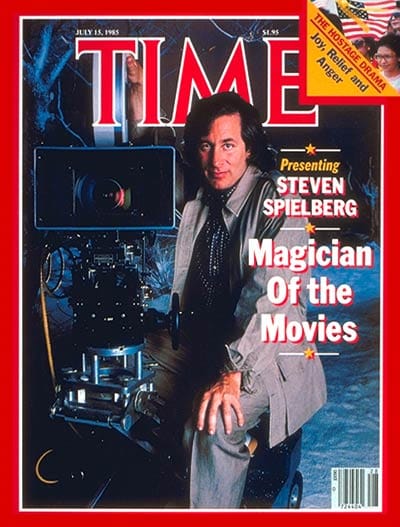
2:31: That is Steven's first cover feature for TIME in the summer of 1985, an interesting time to profile him. At the time, no Spielberg film was in theatres (other than a reissue of E.T.), but it was a busy year for the man. Amblin's offices had been open about a year, and the company was behind that summer's The Goonies and Back to the Future; by year's end, Steven launched the short-lived fantasy anthology TV series Amazing Stories and his next feature, the dramatic The Color Purple. At the time of publication, Steven and soon-to-be-wife Amy Irving welcomed their son Max. It's also the last time he'll be regularly seen in public without a beard.
3:02: Rough draft of The Fabelmans, anyone?
3:41: Another major inaccuracy Steven can cop to—or, perhaps, the editors of his high school yearbook—is the surprisingly common misspelling of his first name.
3:52: This is footage from an event surprisingly undramatized in The Fabelmans: Steven's feature-length 1964 sci-fi film Firelight, shot during his time in Scottsdale, AZ that premiered at the town's local cinema.
4:16: Steven must have been an incredibly good sport to hear about "the legendary Spielberg budget." Famously, JAWS, Close Encounters of the Third Kind and 1941 all struggled with budget and scheduling issues—but after 1941 had a much softer reception than its priors, George Lucas made Spielberg promise a tighter ship on the set of Raiders of the Lost Ark. By this point, he'd largely avoided any trouble and, a breakneck schedule on Hook notwithstanding, would continue to do so.
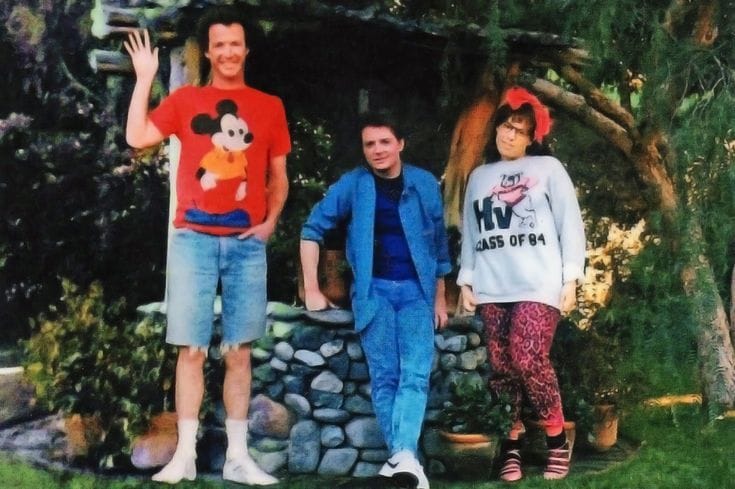
4:46: The merchandise montage is pretty funny, and that shark head is actually located in an otherwise non-functioning well on Amblin's courtyard. You may recognize the well from the photograph of Marty McFly and his siblings in Back to the Future!
5:20: The faraway footage really does make Steven feel like an unwitting participant in the film.
5:50: Don't forget, Aykroyd and Candy don't merely appear as friends or admirers of Spielberg. Both of them appeared in the ensemble cast of Steven's misfiring World War II comedy 1941, with SCTV veteran Candy predating his Hollywood work in both The Blues Brothers and Stripes.
8:07: Again, The Fabelmans was not that exaggerated.
8:20: Though not identified by chyron, this is Anne Spielberg, the oldest of his three younger sisters. A writer by trade, the following year she'll earn her biggest credit in Hollywood, co-writing and co-producing the hit film Big.
9:08: Another sister! This is Nancy, his youngest. In recent years, she's worked as a producer of documentaries about Jewish and Israeli cultural stories.
9:44: And one more: Sue Spielberg is the third child of the family. She seems to be the only one not part of the movie business, but did consult with her sisters on The Fabelmans.
9:59: You probably can guess this even if you've not seen The Fabelmans, but that is Leah Posner Spielberg, who did indeed divorce Arnold and marry his best friend Bernie Adler. After Steven made it big in Hollywood, Leah and Bernie opened up the kosher restaurant The Milky Way in Los Angeles; she was a familiar fixture there until her death in 2017, at the age of 97; the restaurant is still owned by the family.
10:12: And that, of course, is Arnold Spielberg: Air Corps radio operator, legitimately innovative computer engineer and root cause of his son's most enduring cinematic (and real-life) trauma. Much hay has been made as to when the once-estranged father and son eventually reconciled; it was even the subject of a LIFE spread in 1999. But he is clearly present here, and a reignited bond of some sort—especially after Steven himself became a father—would certainly inform the third Indiana Jones film just a few years later. (Arnold lived a full life, continuing to consult on computer ideas until just before his death in 2020, at the age of 103.)
Imagine talking about computers—or anything—with such lucidity at the age of 101!
12:52: "A little off, but very nice." Like Aykroyd in the '80s, Spielberg's victory is one for anyone who's ever dreamed of making their neurodivergence everyone's problem.
14:10: One of the great pieces of Spielberg lore is his first, disastrous attempt at making a filmic calling card of his own. He spent part of 1967 making Slipstream, convinced that he could complete it for under $5000. IMDb says it was about a "group of people addicted to drugs, fans of rock group Slipstream," though none of the beautiful bicycle footage corroborates that summary. The man standing and jokingly grousing about "stooping" to producing and directing is Tony Bill, a bit player who did indeed go behind the scenes, winning an Oscar for Best Picture for The Sting. (That film's executive producers, Richard Zanuck and David Brown, would produce Spielberg's first two films for Universal, The Sugarland Express and JAWS. Bill would later direct films like 1980's underrated My Bodyguard and appear in pictures including Shampoo and Pee-wee's Big Adventure, where he played the head of Warner Bros. Pictures.)
14:53: A very crucial collaborator on Slipstream, seen here in a dusty film vault, is director of photography Allen Daviau. Daviau would also shoot Spielberg's successful attempt at making a filmic calling card, the 1968 short Amblin' (a-ha!), and reunited on several of Steven's most visually arresting films of the '80s, including E.T. The Extra-Terrestrial, The Color Purple and Empire of the Sun. He also shot Defending Your Life, Bugsy, Congo and Van Helsing. He tragically passed away long after his seeming retirement, one of Hollywood's early victims of the COVID-19 pandemic.
If there is one Spielberg project Criterion could do, it could be a presentation of Spielberg's early freelance work and, perhaps, his Universal television projects.
15:15: Bizarrely, this is the only "appearance" in Citizen Steve of his longtime composer and friend John Williams. (At the time, Williams was on a tour of Japan, and also experiencing some of the chronic back pain that would dog him later in life.)
16:12: Attempting to be the Jedediah of Citizen Steve, that's JAWS and Close Encounters' own Richard Dreyfuss.
16:43: Unfortunately, that's not exactly a throwaway gag: Spielberg did at one point have a pied-à-terre at the Trump Tower. According to The New York Times, he "barely" stayed there, but did offer it to—you cannot make this up—Hillary Clinton as a place to crash while campaigning for Senate in 2000.
17:07: William "Scotty" McGlynn was the actual guard at Universal's main gate, and figures into a legendary (false) story about a young Spielberg confidently waving his way into the studio's office and occupying an empty office for a summer. He later appeared as a studio security guard in a 1989 episode of Columbo, a show whose first regular episode was directed by Spielberg himself.
17:18: Sidney Sheinberg was a lawyer for MCA/Universal who was impressed by Amblin' and offered Steven a multi-year television contract, opening up the door for his work on Night Gallery, the TV movie Duel and other work before transitioning to film. By that point, Sheinberg became the president of MCA/Universal, defending Spielberg from detractors during the rocky production of JAWS and celebrating the blockbuster success of E.T. and later Jurassic Park. He was a crucial guiding force in Spielberg's career—it was he who insisted for more than a decade that the director adapt Thomas Keneally's Schindler's Ark into a film—and based on the cadence of this appearance, does not seem to realize he is in a satirical short, even though, as you'll see in a moment, he filmed over two days in two different outfits.
17:33: Also offering a formal tone here is Lew Wasserman, the Hollywood kingmaker who climbed from savvy talent agent to the decades-long head of Universal's parent company MCA. (In case you're wondering: yes, his grandson is absolutely that Wasserman. Yikes!)
17:56: Dennis Weaver offers one of the funniest cameos, smartly evoking his lead role as the protagonist of Spielberg's breakthrough TV movie Duel.
Duel was recently released on 4K, including the original TV cut (before additional scenes were filmed for an international theatrical release); unfortunately, fans took the quality of both cuts to task thanks to presumed AI upscaling on the longer version and little image clean-up on the original.
18:38: Of course, Robin Williams was a treasured friend of Steven's, starring in Hook and also offering crucial assistance to the director by way of stream-of-consciousness long-distance phone calls to quell his nerves while shooting Schindler's List in Krakow, Poland.
19:22: Robin's line about "Jake" was rooted in fact; here's Jake Steinfeld, personal trainer of both Spielberg and Harrison Ford during the filming of the Indiana Jones films and star of this wild album full of session heavy-hitters. (His niece is Hailee, an actress in her own right.)
19:40: One of the funnier meta-moments depicts Robert Zemeckis and Bob Gale writing the script to the then-in-development Back to the Future Part II in a hot tub. (Zemeckis has been open about Spielberg's mentorship; Spielberg executive produced Zemeckis' first two films, I Wanna Hold Your Hand and Used Cars, and hired the Zemeckis/Gale duo to write 1941.) As the pair joke about here, Spielberg's executive producer status on Back to the Future saved the film from being bizarrely retitled Spaceman from Pluto at Sheinberg's request; Steven responded to the memorandum as if it were a joke, knowing the executive would be too proud to correct him.
20:24: Spielberg's friendship with Michael Jackson began when Quincy Jones convinced the duo to work together on a storybook album adaptation of E.T., recorded while Michael was at work on Thriller. The King of Pop was allegedly considered for the lead in a Spielberg-fronted Peter Pan adaptation at Paramount, which shared no DNA with Hook. Their friendship reportedly soured after Jackson used two antisemitic slurs in the lyrics to "They Don't Care About Us" in 1995.
20:59: Among th0se appearing in this final montage include George Lucas, Drew Barrymore, Christian Bale (who starred in Steven's then-newest film, Empire of the Sun), Carl Weathers (who had a cameo in Close Encounters of the Third Kind), Whoopi Goldberg (star of The Color Purple), cult film director Paul Bartel, Gene Shalit, Gremlins director Joe Dante, Michael J. Fox and Barbra Streisand.
22:17: The last word in the Kane parody hilariously goes to Spielberg's longtime producing partners, Kathleen Kennedy—yes, the same one that made Star Wars fans insane—and Frank Marshall. (Kennedy was plucked from being Spielberg's assistant on the set of Raiders to producing E.T., for which she was nominated for a Best Picture Oscar; I take no offense with her.) The duo would marry that same year.
22:49: And that is, presumably, the actual Rosebud sled from Citizen Kane that Spielberg owns. He purchased it for $60,500 in a Sotheby's auction in 1982, a balsa wood model that went unburned while shooting the film's denouement. It's now on permanent loan at the Academy Museum. (You'll also see an E.T. clothes hamper on the truck, pristine models of which command top dollar among collectors.)
Steven would rarely be so lightly mythologized, other than, perhaps, an engaging gala event awarding him the American Film Institute's Life Achievement Award in 1995 that was broadcast on NBC (but this version is even longer than what aired!). Spielberg largely avoided getting too involved in the mythmaking, save for his suggestions throughout the late '90s that he'd direct a script of his sister's entitled I'll Be Home—the earliest seeds of what he and Tony Kushner would cultivate for The Fabelmans more than two decades later. Indeed, Spielberg's filmography and biography are a flower that will only keep blooming this year, with a new potential blockbuster in the wings and a milestone birthday at the end of the year. (Yes, I got the date right.)